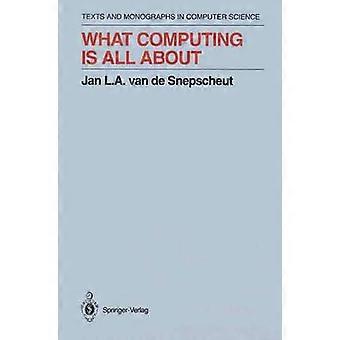
What Computing Is All About

104,00 €
+ 5,49 € Envío

What Computing Is All About
  • Marca: Unbranded
Vendido por:

What Computing Is All About

  • Marca: Unbranded

104,00 €

En existencias
+ 5,49 € Envío

Política de devoluciones de 14 días

Vendido por:

104,00 €

En existencias
+ 5,49 € Envío

Política de devoluciones de 14 días

Aceptamos los siguientes métodos de pago

Descripción

What Computing Is All About

1 What Is Computing All About? 1. - 2 Grammars 11. - 2. 1 Strings and Languages. - 2. 2 Grammars. - 2. 3 The Language Defined by a Grammar. - 2. 4 Bibliographic Notes. - 2. 5 Exercises. - 3 A Program Notation. - 3. 1 Introduction. - 3. 2 The Simple Statements. - 3. 3 The Conditional Statement. - 3. 4 The Iterative Statement. - 3. 5 Procedures. - 3. 6 Recursion. - 3. 7 Bibliographic Notes. - 3. 8 Exercises. - 4 Regular Expressions. - 4. 1 Right-Linear Grammars. - 4. 2 Transition Graphs. - 4. 3 Regular Expressions. - 4. 4 The Relation Between the Three Formalisms. - 4. 5 Equivalence Relations and Finite-State Automata. - 4. 6 Bridling Nondeterminism. - 4. 7 Bibliographic Notes. - 4. 8 Exercises. - 5 Integrated Circuits. - 5. 1 Semiconductor Physics. - 5. 2 Semiconductor Junctions. - 5. 3 MOS Transistors. - 5. 4 Combinational Circuits. - 5. 5 State-Holding Devices. - 5. 6 Sequential Circuits. - 5. 7 Variations. - 5. 8 Bibliographie Notes. - 5. 9 Exercises. - 6 Recursive Descent Parsing. - 6. 1 Top-Down Parsing. - 6. 2 Recursive Descent Parsing. - 6. 3 Limitations. - 6. 4 Lexical Analysis. - 6. 5 LR(k) Parsing. - 6. 6 Bibliographic Notes. - 6. 7 Exercises. - 7 The Halting Problem and Formal Proofs. - 7. 1 The Halting Problem. - 7. 2 Logic and Boolean Expressions. - 7. 3 Gödel's Incompleteness Result. - 7. 4 Cantor's Diagonal Argument. - 7. 5 Calculating with Boolean Expressions. - 7. 6 Formal and Informal Mathematics. - 7. 7 Bibliographic Notes. - 7. 8 Exercises. - 8 Some Programming Heuristics. - 8. 1 Omit a Conjunct. - 8. 2 Replace a Constant by a Variable. - 8. 3 Enlarge the Range of a Variable. - 8. 4 Reduce the Problem Size. - 8. 5 Random Examples. - 8. 6 Conclusion. - 8. 7 Bibliographic Notes. - 8. 8 Exercises. - 9 Efficiency of Programs. - 9. 1 A Lower Bound for Searching. - 9. 2 Analysis of Nested Loops. - 9. 3 The Constant Factor. - 9. 4 Conclusion. - 9. 5 Bibliographic Notes. - 9. 6Exercises. - 10 Functional Programming. - 10. 1 LISP. - 10. 2 Well-Founded Definitions. - 10. 3 More Examples of LISP Programs. - 10. 4 A LISP Interpreter Written in LISP. - 10. 5 A LISP Interpreter Written in Pascal. - 10. 6 Discussion. - 10. 7 Bibliographic Notes. - 10. 8 Exercises. - 11 Program Inversion. - 11. 1 Inversion of Programs. - 11. 2 Reversible Computations. - 11. 3 Circuits Built from Reversible Gates. - 11. 4 Reversible Gates Built from Billiard Balls. - 11. 5 DNA and Turing Machines. - 11. 6 Hot-Clock nMOS. - 11. 7 Bibliographic Notes. - 11. 8 Exercises. - 12 A Collection of Nice Algorithms. - 12. 1 Bresenham's Algorithm. - 12. 2 Computing the Transitive Closure. - 12. 3 Recording Equivalence Classes. - 12. 4 Minimization of Finite Automata. - 12. 5 Oil-Spread Algorithms. - 12. 6 Figure 6. - 12. 7 Huffman's Algorithm. - 12. 8 Bibliographic Notes. - 12. 9 Exercises. - 13 Concurrent Programs. - 13. 1 Mutual Exclusion. - 13. 2 A Subtle Mistake. - 13. 3 Communication via Channels. - 13. 4 Buffers. - 13. 5 Merging Two Streams. - 13. 6 Data Structures. - 13. 7 Matrix Multiplication. - 13. 8 Algorithms that Scale. - 13. 9 Bibliographic Notes. - 13. 10 Exercises. - 14 Implementation Issues: Compilation. - 14. 1 Translating from One Notation to Another. - 14. 2 Expressions. - 14. 3 Nomenclature. - 14. 4 Assignment Statement. - 14. 5 Parameters. - 14. 6 Flow of Control. - 14. 7 A Word About Big and Small. - 14. 8 Arrays. - 14. 9 Side Effects. - 14. 10 Peephole Optimization. - 14. 11 From Stack Machine to Register Machine. - 14. 12 Range Analysis. - 14. 13 Concurrency. - 14. 14 Assembly. - 14. 15 Bibliographic Notes. - 14. 16 Exercises. - 15 An Example of a Compiler. - 15. 1 The Program Notation Pascal-S. - 15. 2 The Stack Machine. - 15. 3 The Compiler. - 15. 4 Bootstrapping. - 15. 5 Bibliographic Notes. - 15. 6 Exercises. - 16 The Construction of a Processor. - 16. 1 ProcessorOrganization. - 16. 2 The ALU. - 16. 3 The Controller. - 16. 4 Multicomputers. - 16. 5 Bibliographic Notes. - 16. 6 Exercises. - A Answers to Some of the Exercises. - B Bibliography. Language: English
  • Marca: Unbranded
  • Categoría: Informática e Internet
  • Idioma: English
  • Número de páginas: 478
  • Fecha de publicación: 2011/09/22
  • Artista: Jan L.A.van de Snepscheut
  • Editor / Marca: Springer
  • Formato: Paperback
  • Nº de Fruugo : 337914159-741573649
  • ISBN: 9781461276395

Entrega y devolución

Enviado en un plazo de 5 días

  • STANDARD: 5,49 € - Entrega entre mar 30 diciembre 2025–vie 02 enero 2026

Envío desde Reino Unido.

Hacemos todo lo posible para asegurarnos de que se le entreguen los productos que pida en su totalidad y de acuerdo con sus especificaciones. Sin embargo, si recibe un pedido incompleto o artículos diferentes a los que pidió, o hay alguna otra razón por la que no está satisfecho con el pedido, puede devolver el mismo o cualquier producto incluido en él y obtener un reembolso completo por los artículos. Vea la política de devolución completa